
In the 21st century, cities compete with each other for much more than investment, talent or tourism. They also compete to build a story: that of innovative territories, open to the world, cosmopolitan and safe, capable of generating opportunities for the people who live there and for those who decide to bet on their future.
In recent years, the concept of the global city has become one of the central ideas for understanding the economy and contemporary urban policy. The sociologist and economist Saskia Sassen coined this term to describe those metropolises that act as strategic nodes of the world economy.
London and New York usually occupy the top positions in international rankings. Behind them appear other global capitals such as Paris, Singapore, Hong Kong, Tokyo or Dubai, while Beijing and Shanghai also consolidate their presence in this group of cities that set the pace of globalization.
In the Middle East, some cities have decidedly opted for this development model. Dubai is probably the best-known example. What was a small settlement dedicated to fishing and the pearl trade just over a century ago has transformed into one of the most dynamic metropolises on the planet.
The discovery of oil in 1966 allowed an ambitious modernization process led by Sheikh Rashid bin Saeed Al Maktoum to be launched. From that moment on, strategic infrastructures were developed that would mark the future of the city: Port Rashid, Jebel Ali Port —now one of the largest artificial ports in the world—, Dubai Drydocks, the expansion of the natural estuary of Dubai Creek and the Dubai World Trade Centre. These investments laid the foundations for a diversified economy oriented towards international trade, logistics, tourism and financial services.
Today, architectural icons such as the Burj Al Arab and the Burj Khalifa symbolize the transformation of Dubai into a global city that combines economic ambition, urban innovation and international projection.
In the region, Doha, the capital of Qatar, has also been the protagonist of a remarkable urban and economic transformation in recent decades. Based on income from natural gas, the city has promoted a modernization strategy based on infrastructure, education, culture and international projection. The organization of major global events, the development of new urban districts and the commitment to innovation have contributed to positioning Doha as a new regional hub that aspires to consolidate itself as a global city in the Middle East.
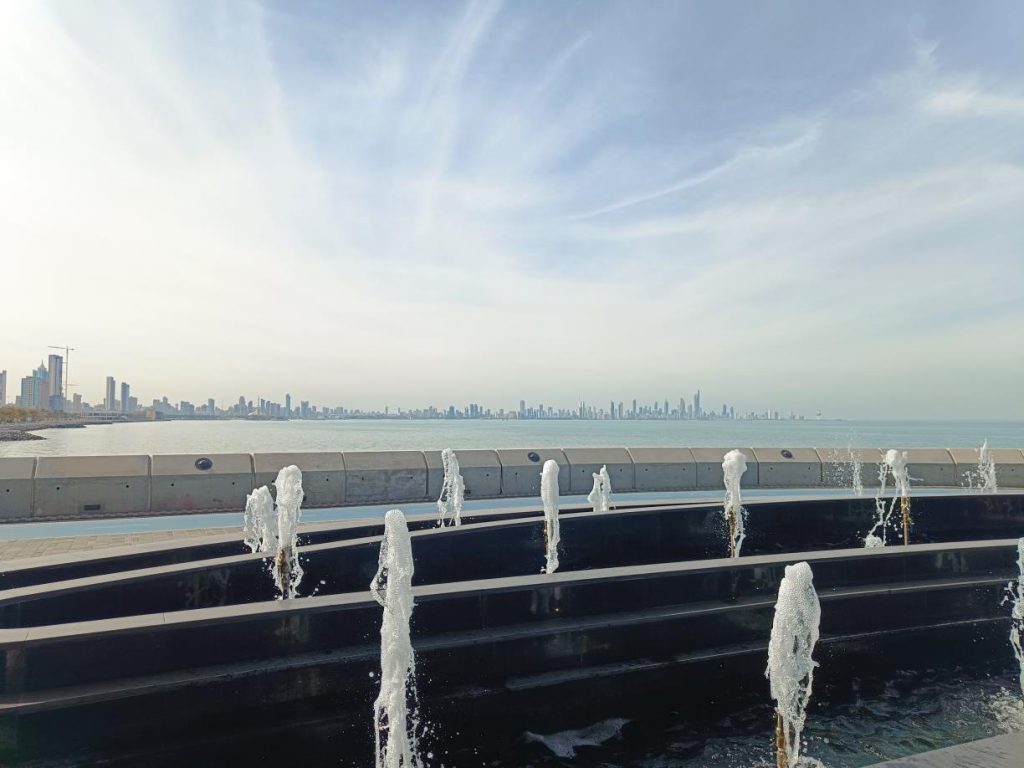
A different process, although equally significant, has developed in Kuwait. The discovery of significant oil reserves in 1938 allowed the country to begin a profound modernization process after the Second World War. Independence from the United Kingdom in 1961 opened a new stage of institutional and social development based on public investment, the creation of infrastructure and the consolidation of a welfare system.
Kuwait’s recent history was marked by the Iraqi invasion of 1990, which caused serious economic and urban damage. After the country’s liberation, the Kuwaiti government promoted a process of reconstruction and modernization with the aim of strengthening Kuwait City’s role as a regional center for business and services.
Both Dubai and Kuwait City —along with emerging cities such as Doha— have built an international story based on innovation, security, economic openness and the generation of opportunities in recent years. This positioning is part of their strategy to attract talent, companies and investment, consolidating themselves as a hub of economic activity in the region.
But the true value of this story is tested in times of greatest difficulty. It is then that cities must demonstrate whether their development model is truly oriented towards the well-being of their citizens.
In the current context of geopolitical tensions and regional conflict in the Middle East, political and institutional leaders in these territories are demonstrating that the concept of a global city is not based solely on skyscrapers or large infrastructures. It is based, above all, on the capacity of institutions to act responsibly, guarantee stability and protect the population.
When a city tells the world a story of growth, modernity, security and opportunities, it builds a reputation. But this reputation is only consolidated when, in complex moments, institutions respond with actions.
Dubai, Doha and Kuwait City are demonstrating this: that institutional leadership and commitment to citizens are an essential part of their development model. Because, after all, the true strength of a global city is not measured only by its economic impact or its international visibility, but by its capacity to care for and protect the people who live there.